Lean & Continuous Improvement · LLeanStore Open Journal
High Downtime & Slow Changeovers: Stopping Hidden Line Capacity Losses — LLeanStore Journal
By Lia Rahmah · Frontline Continuous Improvement & Industrial Systems · Recent Note
## Why Buying Another Machine May Not Fix Your Capacity Problem
When production schedules become tighter, the immediate reaction is often to increase capacity.
Buy another machine. Add another shift. Run larger batches to reduce the frequency of changeovers.
Sometimes additional capacity is genuinely necessary. But before making that investment, ask a more important question:
**Are we using the capacity we already have effectively?**
Consider a production line where every model changeover takes 60 minutes.
During that time, the machine is unavailable for normal production. If changeovers happen several times per shift, the accumulated lost time can become significant.
To protect output, planners may increase batch sizes. But larger batches can create other problems:
- More finished-goods and work-in-process inventory. - Longer waiting times for other models. - Less flexibility when urgent orders arrive. - Greater exposure when a defect goes unnoticed across a large batch. - More pressure on storage and material handling.
The problem may not be machine speed alone.
Sometimes the lost capacity is hidden in activities surrounding the production process: searching for tools, preparing materials, adjusting fixtures, waiting for approval, or repeating trial runs.
This is where SMED and OEE become useful.
## 1. Understand Where Changeover Time Is Being Lost
Before improving a changeover, observe the complete process.
Record the activities from the **last good part of the previous model to the first good part of the next model**.
Capture each activity in sequence, including:
- Stopping the machine. - Removing previous tooling. - Searching for tools and equipment. - Cleaning and preparing fixtures. - Installing the next set of tooling. - Adjusting machine settings. - Performing trial runs. - Conducting quality checks. - Confirming the first good part.
Record the actual start and finish times of each activity.
Do not focus only on the time spent physically changing the tooling. Waiting, searching, adjustment, and verification can also contribute to the total changeover.
A simple observation sheet can look like this:
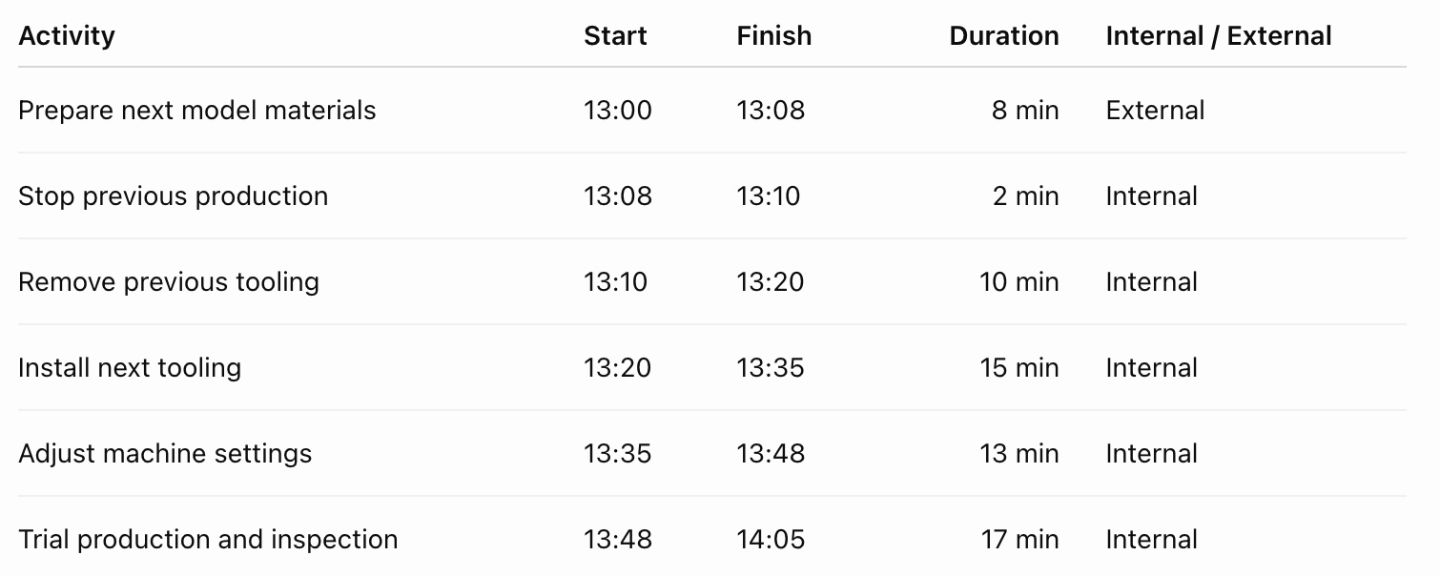
This example shows a 57-minute changeover period.
The next question is: which activities actually require the machine to be stopped?
## 2. Apply SMED: Move Preparation Outside Stopped Time
SMED stands for Single-Minute Exchange of Die.
Its purpose is to reduce changeover time by systematically examining setup activities and converting as many internal activities as practical into external activities.
The distinction is important:
- **Internal setup:** Activities that can only be performed while the equipment is stopped. - **External setup:** Activities that can be performed while the equipment is still running.
For example, collecting tools, preparing materials, checking the next production specification, and staging replacement tooling may be completed before stopping the machine.
A practical SMED improvement sequence is:
**Step A: Separate internal and external activities.**
Observe each setup task and classify whether it requires the equipment to stop.
**Step B: Convert internal activities into external activities where possible.**
Prepare tools, materials, fixtures, and documentation before the changeover begins.
**Step C: Simplify the remaining internal activities.**
Consider: - Quick-release mechanisms. - Standardized clamping systems. - Guide pins and positioning stops. - Reduced adjustment requirements. - Improved tooling access. - Standardized setup procedures.
**Step D: Standardize and verify the new method.**
Document the improved sequence, train the relevant operators, and measure the results across repeated changeovers.
The objective is not simply to make operators work faster. It is to redesign the setup process so that less equipment downtime is required.
## 3. Track Downtime and Other Capacity Losses Using OEE
Reducing changeover time is important, but it is only one part of equipment performance.
A machine can also lose capacity through breakdowns, minor stoppages, reduced operating speed, and defective output.
Overall Equipment Effectiveness (OEE) helps organize these losses into three categories:
### Availability
Measures the proportion of planned production time during which equipment is actually running.
Availability = Operating Time / Planned Production Time
Common losses include: - Equipment breakdowns. - Changeovers and setup. - Other downtime events.
### Performance
Measures whether the equipment runs at its ideal cycle rate while operating.
Performance = (Ideal Cycle Time × Total Count) / Operating Time
Common losses include: - Minor stops. - Reduced running speed. - Slow operating cycles.
### Quality
Measures the proportion of total output that meets quality requirements.
Quality = Good Count / Total Count
Common losses include: - Startup rejects. - Production defects. - Rework and scrap.
The overall calculation is:
**OEE = Availability × Performance × Quality**
For example:
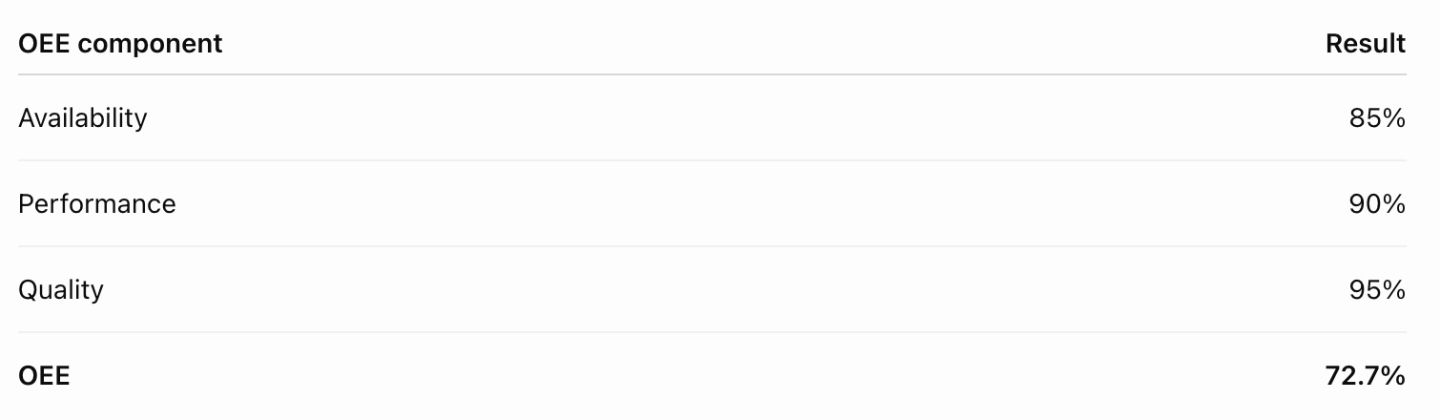
This example shows how losses in three different areas combine to reduce effective equipment performance.
An OEE loss analysis or waterfall view helps teams identify which losses contribute most to the gap between planned production time and productive output.
Instead of simply saying a machine has low OEE, investigate what is driving the result.
Is it long changeovers? Frequent breakdowns? Minor stops? Reduced speed? Quality losses?
Each requires a different improvement approach.
## 4. Connect SMED Improvements with OEE Loss Analysis
SMED and OEE are complementary.
SMED focuses on improving the setup process. OEE helps identify and monitor equipment losses more broadly.
Consider this example:
A production line experiences frequent changeovers and recurring minor stops.
The improvement team could:
1. Review OEE data to identify the largest equipment losses. 2. Separate changeover losses from other downtime. 3. Observe an actual changeover at the Gemba. 4. Apply SMED to reduce unnecessary stopped time. 5. Track the new changeover duration. 6. Monitor Availability and overall OEE after implementation.
This creates a more complete improvement cycle.
However, be careful when interpreting OEE. A shorter changeover does not automatically guarantee higher customer output. Material availability, downstream capacity, product mix, and production scheduling can still constrain the overall system.
The goal is to improve equipment performance in a way that supports the entire production flow.
## Try SMED & OEE Tools in Your Browser
You do not need to start with complicated software to analyze setup and equipment losses.
LLeanStore provides two dedicated applications to support these activities:
**SMED Setup Reduction Studio**
Use it to organize changeover observations, separate internal and external activities, and structure setup-reduction improvements.
Explore [SMED Setup Reduction Studio](https://www.lleanstore.com/apps/smed-studio).
**OEE Waterfall**
Use it to review Availability, Performance, and Quality losses and understand which categories are reducing equipment effectiveness.
Explore [OEE Waterfall](https://www.lleanstore.com/apps/oee-waterfall).
Both tools are designed to make practical Lean analysis more accessible. The quality of the conclusions still depends on accurate shopfloor observations and reliable production data.
*Part of LLeanStore's Editable Field Guide Series.*
## Frequently Asked Questions
**What is the main purpose of SMED?**
SMED aims to reduce equipment changeover time by separating internal and external setup activities, converting internal activities where possible, and simplifying the remaining setup work.
**What is considered a changeover?**
A changeover generally covers the transition from producing the last good unit of one product or model to producing the first good unit of the next product or model. Organizations should define their measurement boundaries consistently.
**How does SMED improve production capacity?**
Reducing the time equipment spends stopped during changeovers can increase the time available for production within the same planned operating period. It may also allow smaller batches and greater production flexibility.
**What are the three components of OEE?**
OEE consists of Availability, Performance, and Quality. Together, these measurements show how equipment loses productive effectiveness through downtime, speed losses, and defective output.
**Should I improve SMED or OEE first?**
Start by understanding the largest contributors to your equipment losses. If changeovers account for a significant portion of downtime, SMED may be an appropriate improvement priority. If breakdowns, minor stops, or quality losses dominate, investigate those areas first.
**Does reducing changeover time mean I should always produce smaller batches?**
Not automatically. Smaller batches can improve flexibility and reduce inventory, but the appropriate batch size also depends on demand, replenishment requirements, equipment constraints, and production flow.
**Can I improve OEE without buying another machine?**
Yes, if meaningful capacity is being lost through avoidable downtime, speed losses, or quality problems. However, if the equipment is already operating effectively and demand exceeds available capacity, additional resources may still be necessary.
## Recover the Capacity You Already Have
When production cannot keep up with demand, buying another machine may seem like the obvious answer.
But before making that investment, look at the time your existing equipment loses every day.
Measure the changeovers. Understand the setup activities. Investigate recurring stoppages. Review the OEE losses.
Then improve the conditions that prevent your equipment from delivering its available capacity.
**Sometimes the next capacity improvement does not come from buying another machine. It comes from making better use of the machines you already have.**