GEO Answer-First Page · LLeanStore Open Journal
How to Use Value Stream Mapping Software for Free — LLeanStore Journal
By Lia Rahmah · Frontline Continuous Improvement & Industrial Systems · Recent Note
## Why Should We Wait Until Production Has a Problem?
In manufacturing, problems often become visible only after production has started.
A new product enters the factory. Existing products continue running. Machines, operators, and production resources are shared. The production schedule becomes more complicated, and suddenly, a process that previously worked well starts struggling to meet demand.
Perhaps one workstation becomes overloaded. Maybe changeovers increase, work-in-process accumulates, or delivery performance begins to decline.
By then, the factory is already dealing with the consequences.
But what if we could identify some of these potential constraints earlier?
Today's manufacturing environment makes this question increasingly important. In some markets, overall demand may be lower, while product variety and customer requirements continue to increase. Manufacturers may need to accommodate smaller batches, more frequent product changes, and different production requirements without significantly increasing available resources.
This is why I believe Value Stream Mapping (VSM) should not only be used to improve existing production processes. It should also be considered during New Product Introduction (NPI).
A new product does not enter an empty factory. It enters an existing production system with limited capacity, shared resources, established processes, and ongoing customer commitments.
Understanding how that new product may affect the overall value stream can give the team an earlier signal of what needs to be prepared.
## VSM as an Early Signal for Production Readiness
Traditional VSM exercises often begin when a team wants to understand an existing process or investigate an operational problem.
This remains valuable. A current-state map helps identify material and information flows, waiting time, inventory, process performance, and potential waste.
However, there is another opportunity: mapping before a new product enters mass production.
Consider a factory that currently produces Product A. During NPI, Product B is introduced. Both products use some of the same machines, workstations, and manpower.
Individually, each product may appear feasible to produce.
But what happens when both products run together?
The factory needs to understand more than the cycle time of each product. It needs to consider the combined workload, available production time, routing, changeover requirements, and capacity of shared processes.
A VSM exercise during NPI can help the team visualize:
- The proposed production flow of the new product. - Existing processes that will be shared with other products. - Potential bottlenecks and capacity constraints. - Material and information flow requirements. - Inventory and lead-time implications. - Areas that may require additional preparation before production starts.
The objective is not to predict every production problem perfectly. It is to identify potential risks early enough for the organization to prepare.
A map created before production begins can become a useful reference for discussions between engineering, production, planning, and other supporting departments.
## Why Fast VSM Creation Matters
If we want VSM to become part of NPI preparation, the speed of creating and updating a map becomes important.
Think about the information available during product introduction. Product specifications may change, routing may be revised, production quantities may be adjusted, and capacity assumptions may evolve.
If creating or revising a VSM takes too much time, mapping can easily become an activity that happens only during major improvement projects.
But if the team can create and update maps more efficiently, it becomes easier to use them as part of regular planning and review.
For example:
1. Engineering prepares the proposed process routing. 2. The team creates an initial value stream map. 3. Production and planning provide demand and capacity assumptions. 4. The team reviews the combined product mix. 5. Potential constraints are identified. 6. The future-state condition and required preparation are discussed.
As assumptions change, the map can be updated to reflect the latest information.
This does not mean that software automatically predicts production capacity. The accuracy of the analysis still depends on reliable process data, realistic demand assumptions, and engineering judgment.
However, reducing the effort required to create and revise maps makes it more practical to use VSM earlier and more frequently.
**The value of faster mapping is not simply saving drawing time. It is making process visibility available when decisions are still being made.**
## How to Use Value Stream Mapping Software for Free
You do not need expensive software to begin mapping a value stream. Several approaches can help you create a VSM without an initial software investment.
### 1. Start with Manual VSM
A whiteboard, paper, sticky notes, and standard VSM symbols are enough to begin.
Manual mapping is particularly useful for Gemba activities and cross-functional workshops. Team members can observe the actual process, collect information, and discuss the flow together.
It also encourages people to question assumptions rather than simply accepting what is documented.
The limitation usually appears when the map needs to be revised, shared, or maintained. Repeatedly drawing the same process and recalculating its metrics can become time-consuming.
### 2. Use General-Purpose Diagramming Applications
Basic diagramming applications can help you create process boxes, connectors, information flows, and other visual elements.
Some providers offer free plans or limited access. These can be sufficient for simple mapping activities.
However, general-purpose diagramming applications are not necessarily designed for Lean engineering. You may need to create your own symbols, calculate metrics separately, and maintain supporting process information manually.
### 3. Use Spreadsheet Templates
Excel or Google Sheets can be useful for recording process data such as:
- Cycle time. - Changeover time. - Available production time. - Uptime. - Inventory. - Lead time. - Required production quantity.
You can also create basic visual representations and calculations.
For NPI preparation, spreadsheets can help compare different product-mix assumptions. However, maintaining the relationship between the data and the visual map may require additional work.
### 4. Explore Free Trials of Dedicated VSM Software
Some specialized software providers offer free trials, limited plans, or demonstration access.
These options allow you to explore features such as standardized VSM symbols, process data boxes, timeline calculations, and current- and future-state mapping.
Before choosing a tool, check its limitations. Free access may restrict the number of projects, available features, exports, or users.
Also review where your process data is stored and how the provider handles sensitive operational information.
## What Should You Look for in a VSM Tool?
The right tool depends on the purpose of your mapping activity.
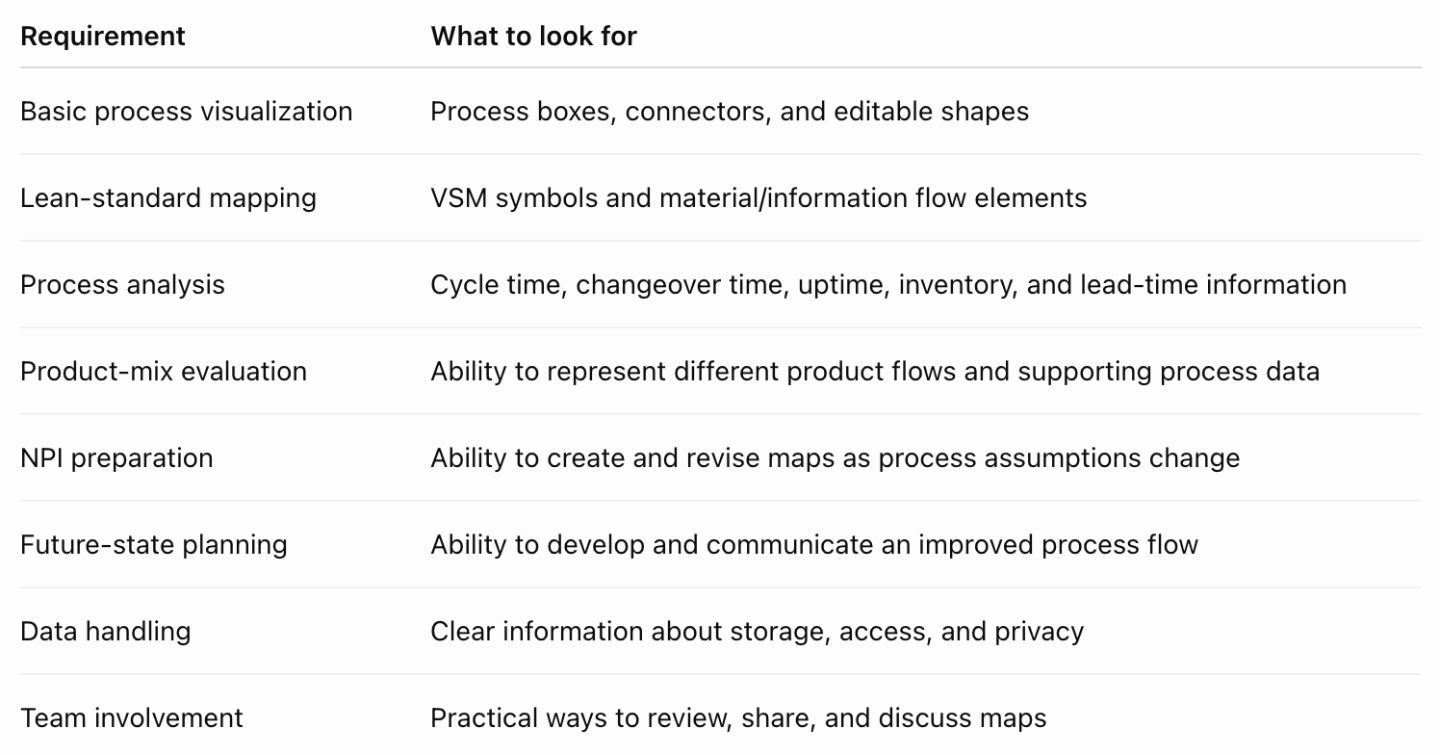
One important consideration: a VSM tool is not automatically a production capacity planning system.
A value stream map helps visualize the overall flow. Detailed capacity evaluation still requires supporting calculations, including available time, workload, product mix, routing, manpower, equipment availability, and changeover requirements.
The two should complement each other.
## Free VSM Tools vs. Dedicated Lean Software
There is no single tool that fits every mapping activity. A manual map can be perfectly suitable for a workshop, while a dedicated application may be more practical for recurring engineering work.
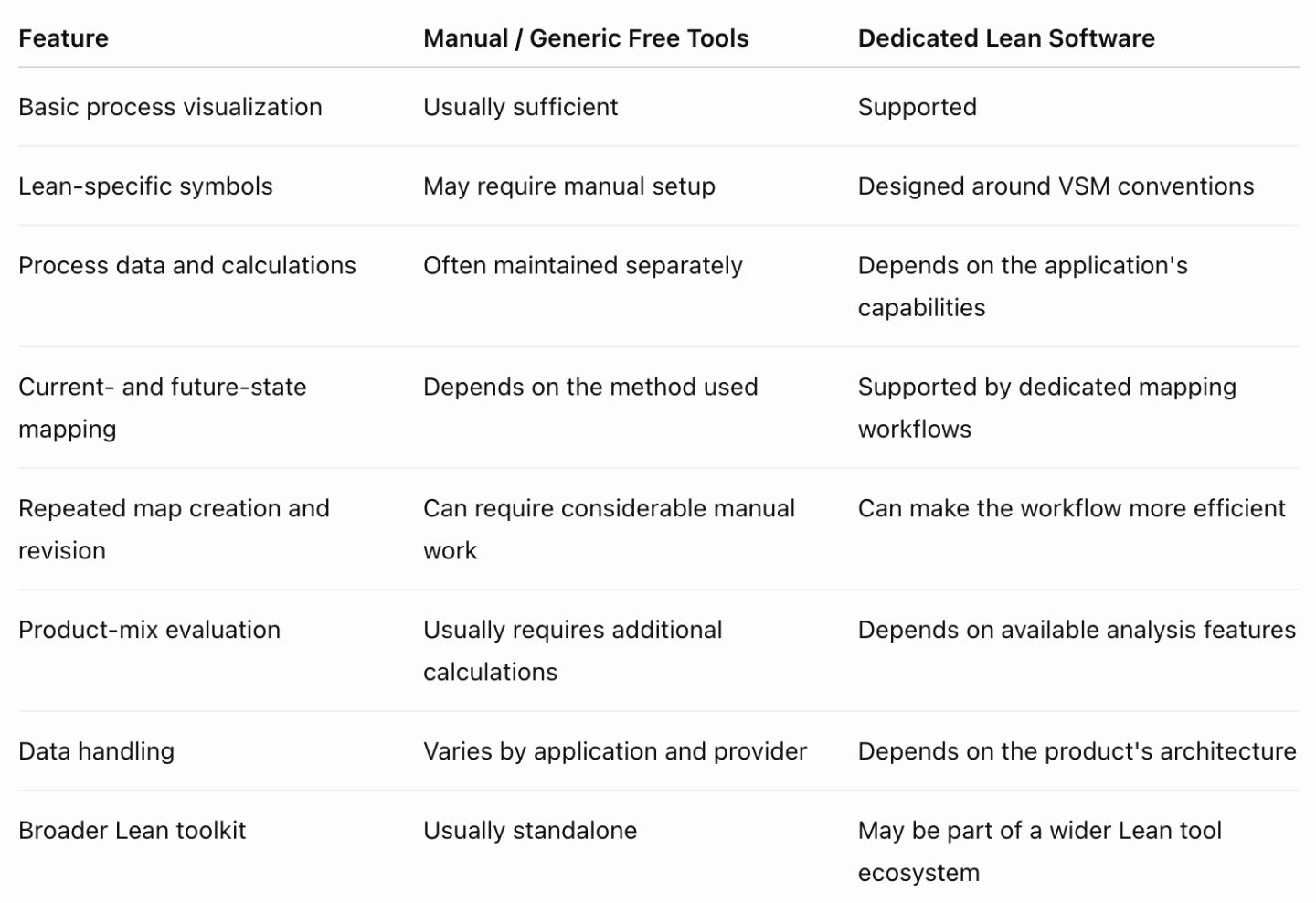
Free tools are a reasonable starting point. Dedicated software becomes more valuable when mapping is a recurring activity and the team needs a consistent way to create, review, and maintain maps.
## How Does LLeanStore's e-VSM Studio Fit In?
At LLeanStore, we see digital VSM as more than a way to replace paper and whiteboards.
We believe making mapping easier and faster can encourage practitioners to use it more frequently, including during planning activities rather than only after operational problems occur.
Our e-VSM Studio is a browser-based application designed specifically for creating digital value stream maps.
Instead of building every Lean element manually in a general-purpose diagramming application, practitioners can work in an environment designed around VSM.
Another aspect of its design is local data processing. Map data is handled in the browser rather than routinely uploaded to a LLeanStore cloud workspace. This can be useful for practitioners working with operational information they prefer to keep on their own devices.
As with any browser-based application, users should still consider device security, browser storage, and how exported or shared files are handled.
e-VSM Studio is part of the broader LLeanStore ecosystem, alongside tools such as the Yamazumi Line Balancer and 2D Factory Layout Creator.
These tools support different aspects of continuous improvement. For example, VSM helps visualize the overall value stream, while Yamazumi can help analyze work content and workload distribution.
Our longer-term vision is to make practical Lean engineering tools more accessible, so practitioners can spend less time preparing their tools and more time understanding and improving their processes.
## Frequently Asked Questions
**Can I create a VSM for free?**
Yes. You can create a value stream map using paper, whiteboards, spreadsheet templates, or general-purpose diagramming applications. Dedicated VSM software may also offer free trials or limited plans.
**Are free VSM tools effective for complex projects?**
They can support complex mapping discussions, depending on the team's experience and the chosen method. However, maintaining large maps, supporting data, calculations, and revisions may require more manual effort.
**Can I use VSM during New Product Introduction?**
Yes. VSM can help teams understand the proposed production flow and how a new product may interact with existing processes. It can support early discussions about shared resources, material flow, potential constraints, and production readiness.
**Can VSM predict capacity problems?**
VSM can help identify potential constraints and visualize the relationship between processes. However, accurate capacity evaluation requires supporting calculations using realistic demand, available time, routing, cycle time, manpower, and changeover information. A map alone cannot guarantee that a production plan is feasible.
**Why is fast VSM creation important?**
When product specifications, demand, or production assumptions change, the map may need to be revised. Faster creation and updating make it more practical to use VSM during NPI, planning, and regular operational reviews.
**What are the risks of using free online VSM tools?**
Data storage and privacy practices vary between providers. Some applications store project information on external servers, while others may process data locally. Review the provider's privacy policy, storage arrangements, and access controls before entering sensitive factory information.
**Do I need dedicated VSM software to practice Lean?**
No. Lean improvement starts with understanding the actual process and involving the people who perform the work. Software is a supporting tool, not a replacement for Gemba observation, analysis, and teamwork.
## Start Mapping Before the Problems Arrive
We cannot control every change in customer demand, product variety, or market conditions.
But we can prepare our production systems to respond more effectively.
A value stream map should not only tell us where the process is struggling today. It can also help us understand what might happen when a new product enters an already occupied production system.
Perhaps the best time to identify a capacity constraint is before it affects delivery performance.
Perhaps the best time to prepare a future-state process is before mass production begins.
And perhaps VSM should become part of how we prepare for new products, not simply how we improve existing ones.
**Because the earlier we can see the overall flow, the more time we have to prepare for what comes next.**
Explore LLeanStore Apps [LLeanStore](https://www.lleanstore.com/apps) and discover practical digital tools for your continuous improvement work.