Lean & Continuous Improvement · LLeanStore Open Journal
Why the Same Issue Returns Every Month (And How to Close Root Causes) — LLeanStore Journal
By Lia Rahmah · Frontline Continuous Improvement & Industrial Systems · Recent Note
## The Trap of Closing Tickets Before Understanding the Problem
Look through a factory's corrective-action records from the previous quarter. You may find familiar defect descriptions appearing repeatedly:
- Material tear. - Wrong product label. - Glue overflow or bloom. - Sensor misreading. - Uneven stitching.
Each incident has a closure date. The action taken often looks familiar too:
- Re-briefed the operator. - Conducted additional inspection. - Sorted the affected batch. - Reminded the team to follow the standard.
These actions may be necessary, but they do not necessarily solve the problem.
Sorting defective products protects the customer from receiving known defects. Re-briefing operators may help communicate expectations. However, neither action proves that the process can no longer produce the same defect.
Imagine a fixture that allows a component to be loaded in the wrong direction. Training operators to pay more attention may reduce mistakes temporarily. But if the fixture still allows incorrect loading, the same problem can return with another operator, another shift, or another busy production day.
**Containment protects the customer today. Root-cause problem solving helps prevent the problem from returning tomorrow.**
The challenge is to move beyond closing incidents and start closing the conditions that allow them to happen.
## How to Break the Repeat-Problem Cycle in 3 Steps
### 1. Define the Gap Using Observable Gemba Facts
Start by describing what actually happened.
Avoid vague conclusions such as:
- Operator careless. - Machine problem. - Material issue. - Lack of awareness.
These statements describe possible explanations, not verified causes.
Instead, compare the expected condition with the actual condition.
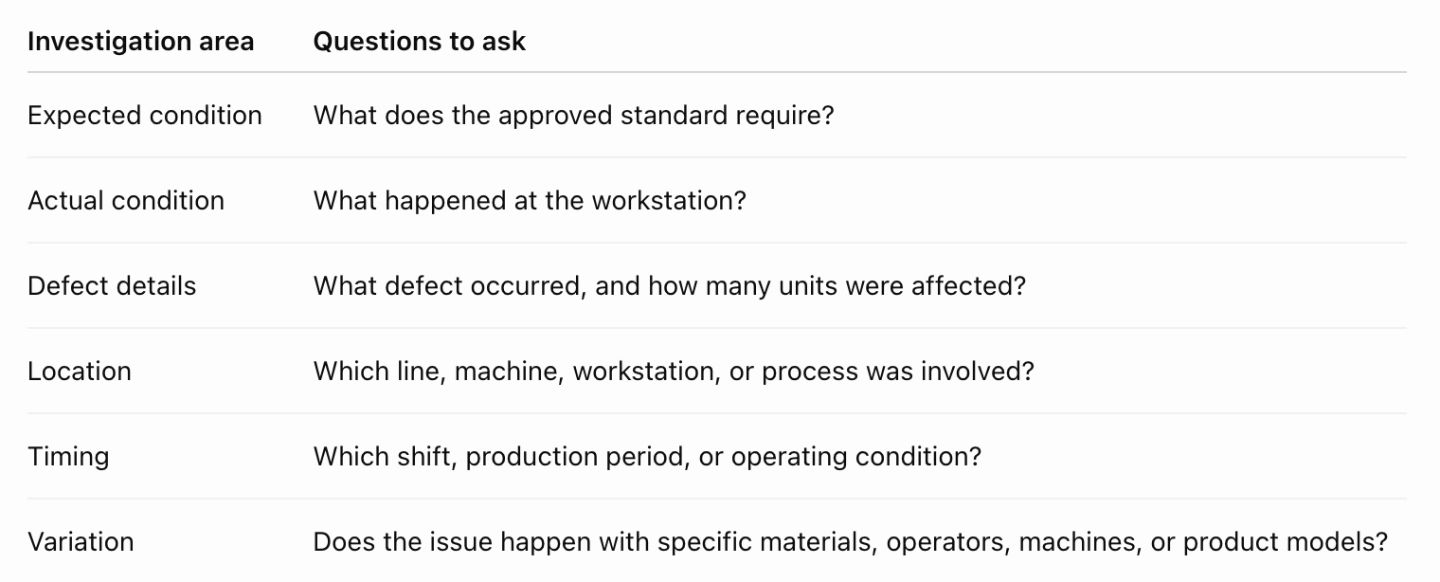
For example:
**Problem statement:** 18 out of 500 units produced on Line 2 during the night shift had uneven stitching.
This is more useful than saying the operator did not follow the standard.
A good problem statement gives the team something specific to investigate.
### 2. Investigate the Causes at the Gemba
Once the problem is clearly defined, go to the actual process.
Use Why-Why analysis to explore the chain of conditions that contributed to the problem.
For example:
**Problem:** A component was repeatedly installed in the wrong orientation.
- Why 1: The component was loaded in the wrong direction. - Why 2: The fixture allowed both orientations. - Why 3: The fixture did not have a physical orientation guide. - Why 4: The fixture design was not reviewed for incorrect-loading risks.
This investigation suggests a potential process-design weakness rather than simply an operator attention issue.
However, do not treat five Why questions as a mandatory formula. Some problems have multiple contributing causes, and some require additional data, testing, or technical analysis.
Check the possible causes against actual evidence.
A useful way to organize the investigation is through the 4M categories:
- **Man:** Skills, knowledge, workload, and human factors. - **Method:** Work instructions, sequence, and standard procedures. - **Machine:** Equipment condition, fixture design, and settings. - **Material:** Material variation, specifications, and incoming quality.
The purpose is not to find someone to blame. It is to understand which conditions made the problem possible.
Where appropriate, consider Poka-Yoke (mistake-proofing). Can the process be designed to prevent the error, detect it immediately, or make the incorrect action physically difficult?
### 3. Verify the Countermeasure Before Closing the Problem
Finding a plausible cause and implementing a countermeasure does not automatically mean the problem is solved.
Follow the PDCA cycle:
**Plan:** Define the problem, investigate causes, and select a countermeasure.
**Do:** Implement the countermeasure on a controlled scale where practical.
**Check:** Measure the result against the original problem. Verify performance across relevant shifts, product variations, and normal production conditions.
**Act:** If the countermeasure works, standardize the improved method. If it does not, return to the investigation and revise the approach.
For example, if a fixture modification is intended to prevent incorrect loading, do not close the action immediately after installation.
Check whether incorrect loading is actually prevented under normal operating conditions. Review defect records and confirm that the countermeasure does not introduce another problem.
Once the improvement is verified:
- Update Standardized Work. - Revise relevant inspection or start-up checklists. - Communicate the new method to affected teams. - Assign responsibility for maintaining the improved condition. - Review recurrence data after implementation.
**A corrective action should be closed because the result has been verified, not simply because the action has been completed.**
## Containment vs. Permanent Countermeasures
These two activities serve different purposes. Both can be necessary, but they should not be confused.
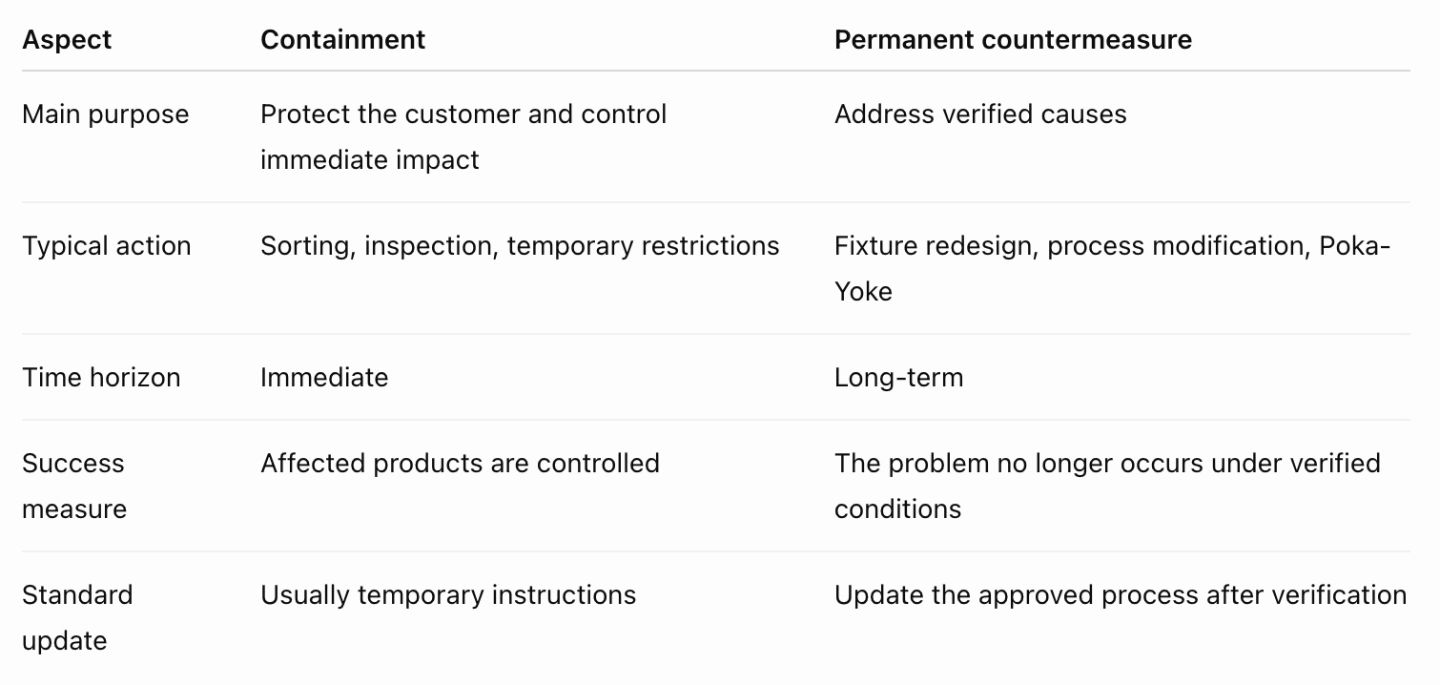
A useful corrective-action record should clearly show which actions are containment measures and which are intended to prevent recurrence.
This makes it harder for temporary actions to be mistaken for completed problem solving.
## Why Do the Same Problems Keep Returning?
Several patterns can make recurring defects difficult to eliminate.
**1. Actions focus on people instead of process conditions.**
Training and communication are useful, but they cannot compensate for every weakness in equipment, methods, or material controls.
**2. Root causes are assumed rather than verified.**
A Why-Why analysis is only useful when its conclusions are supported by evidence.
**3. Corrective actions are closed too early.**
Installing a countermeasure is not the same as confirming its effectiveness.
**4. Improvements are not standardized.**
Even a successful solution can disappear when work instructions, inspection criteria, and training materials remain unchanged.
**5. Recurrence is not reviewed.**
If corrective-action records are not reviewed across time, similar problems may continue to be treated as unrelated incidents.
## Organize Your Problem-Solving Activities with PDCA & A3 Studio
When several improvement actions are open at the same time, it becomes difficult to track causes, countermeasures, owners, and verification results.
At LLeanStore, **PDCA & A3 Studio** helps practitioners structure their problem-solving activities in one digital workspace.
Use it to organize the improvement process, document the problem, record investigation findings, track countermeasures, and follow up on verification.
Instead of treating corrective actions as a list of tickets to close, use a structured PDCA approach to keep attention on the problem and its results.
Explore [PDCA & A3 Studio](https://www.lleanstore.com/apps/pdca).
*Part of LLeanStore's Editable Field Guide Series.*
## Frequently Asked Questions
**What is the difference between corrective action and containment?**
Containment controls the immediate impact of a problem, such as sorting defective products or adding temporary inspections. Corrective action addresses the causes that allowed the problem to occur and aims to prevent recurrence.
**How many Why questions should I ask in a root-cause analysis?**
Five Whys is a common technique, but five is not a mandatory number. Continue asking why until you reach causes that can be supported by evidence and addressed through practical countermeasures. Some problems require several cause paths rather than one simple chain.
**Why is operator retraining not always an effective corrective action?**
Retraining may help when a genuine knowledge or skill gap is confirmed. However, if the process allows mistakes through poor fixture design, unclear standards, or equipment problems, training alone may not prevent recurrence.
**How do I know whether a root cause has been eliminated?**
Define a measurable success criterion before implementing the countermeasure. Then monitor the relevant defect or process indicator under representative operating conditions. Consider different shifts, operators, and product variations where relevant.
**What is the role of PDCA in root-cause problem solving?**
PDCA provides a structured way to define the problem, test countermeasures, evaluate results, and standardize successful improvements. It prevents teams from treating implementation as the final step.
**Should every recurring defect use an A3 report?**
Not necessarily. Simple problems may need a straightforward investigation and action record. More complex, recurring, or cross-functional problems benefit from A3 because it helps communicate the problem, evidence, analysis, countermeasures, and follow-up in one structured format.
## Stop Closing Tickets. Start Closing the Causes.
A corrective-action report can show that a team responded quickly. But the real measure of problem solving is whether the process becomes more reliable afterward.
Contain the immediate problem. Investigate what made it possible. Test the countermeasure. Verify the result. Then update the standard.
The next time the same defect appears, do not simply ask who needs to be reminded.
Ask what condition in the process still allows it to happen.
**Because a problem is not truly solved just because its ticket is closed.**